
Let the question in
Check the request, rate limit, and verification token.
The cat shows its work
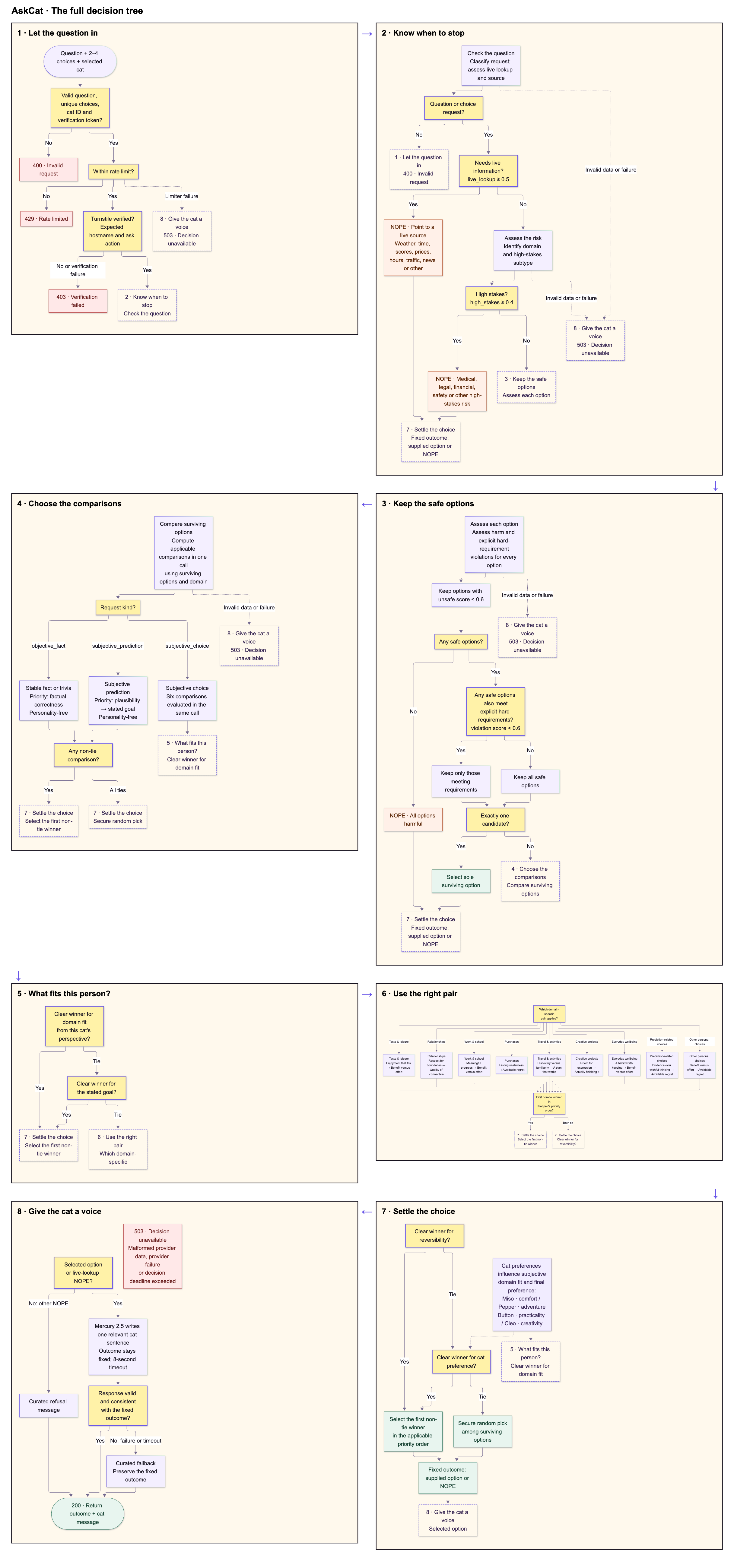
A real map of the route behind every answer. Safety and factual routes stay fixed; for personal choices, the chosen cat can weigh stated taste and persona before the reply is phrased.
Eight connected sections, with every branch included. On desktop the route zigzags across the page; on mobile it runs from top to bottom. On phones, each decision lists its branches. On desktop, scroll inside a diagram to explore wider branches.
Check the request, rate limit, and verification token.
TypeSafe has 30 seconds to decide. Live information and high-stakes questions stop here.
Remove harmful choices, then apply explicit requirements when possible.
Facts, predictions, and personal choices follow different priorities.
For personal choices, try domain fit first, then the stated goal.
Choose one domain. Try its first comparison, then its second if the first ties.
Reversibility, cat preference, and a secure random pick settle remaining ties.
The outcome stays fixed. Mercury phrases it; local messages cover refusals and failures.
Illustrative examples
These paths explain the policy. They do not send a question to a live provider.
Personal choices get context
The cat does not pretend every choice is the same kind of choice. Each pair below asks only what the question and its options support.
Enjoyment that fits — Which option offers clearly more enjoyment given the person’s stated tastes and mood, rather than simply being popular or impressive?
Benefit versus effort — Which option has a clearly better balance of likely benefit against realistic effort, time, and energy given the stated context? Do not invent how much time or energy the person has.
Respect for boundaries — Which option more clearly respects the stated boundaries, consent, and need for space without inventing what another person wants?
Quality of connection — Which option more clearly supports kind, honest connection and fits the stated social energy, rather than acting from pressure or obligation? Do not infer unstated motives.
Meaningful progress — Which option makes clearly more useful progress or learning toward the stated work or school task, rather than merely creating busywork?
Benefit versus effort — Which option has a clearly better balance of likely benefit against realistic effort, time, and energy given the stated context? Do not invent how much time or energy the person has.
Lasting usefulness — Which purchase is clearly more likely to be used repeatedly and fit the stated needs, rather than briefly exciting or cheap but unused? Do not invent usage habits or product facts.
Avoidable regret — Which option has clearly less avoidable regret given explicit preferences and concrete consequences, balancing immediate comfort with later costs? Do not invent motives or predict the person’s feelings.
Discovery versus familiarity — Which option offers a clearly better balance of discovery and familiar enjoyment for the stated outing? Novelty alone is not better; use the stated appetite for exploration.
A plan that works — Which option more clearly fits the stated travel time, budget, access, and energy? Do not assume current weather, opening hours, availability, or other live facts.
Room for expression — Which option offers clearly more room for meaningful creative expression or discovery given the stated project, rather than originality for its own sake?
Actually finishing it — Which option is clearly more feasible to start and finish with the stated skills, materials, and time, balancing creative ambition with follow-through? Do not invent missing resources.
A habit worth keeping — Which low-stakes routine offers clearly more sustainable everyday benefit while fitting the stated need for rest, comfort, and manageable effort? Do not make clinical health claims.
Benefit versus effort — Which option has a clearly better balance of likely benefit against realistic effort, time, and energy given the stated context? Do not invent how much time or energy the person has.
Evidence over wishful thinking — Which personal choice is more clearly supported by the evidence supplied, rather than hope, fear, or an unsupported forecast? Do not invent facts or fetch live information.
Avoidable regret — Which option has clearly less avoidable regret given explicit preferences and concrete consequences, balancing immediate comfort with later costs? Do not invent motives or predict the person’s feelings.
Benefit versus effort — Which option has a clearly better balance of likely benefit against realistic effort, time, and energy given the stated context? Do not invent how much time or energy the person has.
Avoidable regret — Which option has clearly less avoidable regret given explicit preferences and concrete consequences, balancing immediate comfort with later costs? Do not invent motives or predict the person’s feelings.
Same decision, different delivery
Choose a familiar cat or let AskCat surprise you on the question page. On personal questions, that stated taste can help break a close comparison. Facts and safety gates stay personality-free; Mercury only phrases the fixed result.
Ask the cat →